
Showing posts with label Kapampangan personalities. Show all posts

Tuesday, February 8, 2022

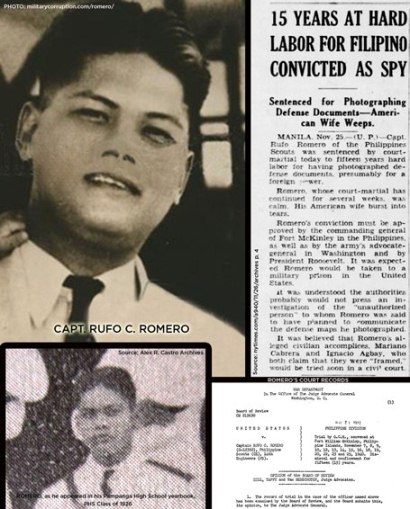
448. Capt. RUFO C. ROMERO: How A Kapampangan West Pointer Became America’s Betrayer

Capt. RUFO ROMERO, convicted military spy, Kapampangan

In late November of 1940, a West Point graduate was convicted of espionage-- at that time, the first and only alumnus of the prestigious United States Military Academy to be court-martialed and charged for attempting to sell classified maps to Japan, via an intermediary. The military officer, Rufo C. Romero, also happens to be a Kapampangan, the illegitimate son of a poor woman with an unknown partner, who, some tongue wags say, was a priest.

Nevertheless, Romero grew up an intelligent child, finishing his secondary education at the Pampanga High School, class of 1926, where he was also a top Cadet Officer. However, it was at the University of the Philippines that  his brilliance showed, leading to an appointment at West Point. He graduated in 1931 with flying colors,  ranking 17th in his class—an incredible feat for a Filipino who, lumped with African-Americans, were considered as minorities.

Armed also with a civil engineering degree from the University of California, Romero seemed bound for an illustrious military career. He found love in the U.S., marrying 17 year old Lorraine Becker of Bronx, New York, before being sent back to the Philippines to serve as captain to the Philippine  Scouts.

The commander of the Philippine Scouts 14th Engineer Regiment recalls that Capt. Romero  was among the U.S. Army's most knowledgeable experts on the topography, road and trail network and defensive positions on Bataan.

Romero would also have known the value of such information to the Japanese and other foreign powers even long before the 1941 Philippine invasion ; there have been several cases in the past where confidential fortification blueprints of Corregidor and Bataan where stolen, lost,  or copied, clearly for use in military espionage. There was circumstantial evidence to suggest that Romero could very well be a spy, thus, a sting operation was hatched by the U.S. Army to entrap him.

The Army drew up a plan where a supposed Japanese-colluding Mindanao sultan was out on the market looking for such maps and classified documents. Romero, along with alleged civilian accomplices Ignacio Agbay and Mariano Cabrera, had photographed copies of Corregidor and Bataan defense maps, which the captain then attempted to sell for $25,000.

It was in this dramatic way that Romero was arrested, and court-martialed at Fort McKinley in November, 1940. By the 24th, he was found guilty of giving secret maps related to national defense to unauthorized persons, a violation of the Articles of War 96.

Professing his innocence, he volunteered to undergo any kind of brain operation that would erase his memories and recollections regarding military matters,  a last-ditch effort to save his tarnished reputation. Romero  was dishonorably discharged, lost all his pay allowances, and sentenced to 15 years of hard labor at McNeil Island Penitentiary in Washington State. His wife, Lorraine, who had connived with him, was not charged.

After Romero served his time in prison, he left the United States to build a new career in the academe back in the Philippines. He taught engineering subjects at the National University  in Sampaloc, Manila, where students remember him as an amiable professor who likes engaging people in friendly conversations. Further distancing himself from his past, he went to Africa and Spain, where his tainted reputation was relatively unknown, and found some engineering jobs.

All this time, his notorious deed led his many fellow Filipinos to ask:  what makes a man of intelligence become a spy? What drives him to become a betrayer of his country, his family, and conscience? The world will never know as Rufo C. Romero  passed away in Spain on 3 January 1985, leaving behind his wife and 3 children in the U.S., remaining quiet about this one act of treachery that changed the course of their lives.

SOURCES:

Scott Harrison;s Espionage Page: https://corregidor.org/crypto/chs_crypto1/sting1.htm

West Point grad convicted for attempting to sell maps of fortifications to a foreign power: https://militarycorruption.com/romero/

Time Magazine: The Philippines: Spy Trial, 2 December 1940

Board of Review Holdings, Opinions and Reviews, https://books.google.com.ph/


Tuesday, November 13, 2018

*440. Race The Wind: JAMIE C. PAMINTUAN, Top Woman Motocross Rider

HER MOTO IN LIFE. Jamie C. Pamintuan, one of the world's top women motocross riders in the 90s decade. Her father, Remy Pamintuan of Angeles City was also an ace motocross biker in his time. Photos courtesy of Terri Cui Pamintuan.
Before Hidilyn Diaz and Margielyn Didal made waves in Weightlifting and Skateboarding respectively—sports that were generally considered  as  men’s domains, there was an audacious, daredevil Kapampangan sportswoman who conquered the sports of motocross racing—rising to the ranks of  the world’s best female riders in the 90s decade.

Jamie Cui Pamintuan, born on 3 January 1979,  has the adventurous streak in her genes, Her father, Remigio “Remy” Pamintuan of Angeles City, was a former ace motocross rider himself, winning the Philippine National Motocross championships from 1969-1976. He was a contemporary of the motorsports legends Butch Chase (Russian-American born in the Philippines) and Ken Falco, who went on to head the National Motorcycle Sports and Safety Association. Her mother, Theresa “Terri” Cui was a USAF daughter who grew up in Clark.

At age 2, Jamie, along with her family migrated to the U.S. Growing up she was involved in various activities, (dancing, martial arts, skating, etc.). She even played softball in high school (Polytechnic Senior High School) on the Jr. Varsity Team. But none of those pursuits really held her interest for very long—except riding her BMX bike. Her father sought out a bike for her, but was appalled at the prices.

”Mas mura pa and motor kaysa sa bisikleta”, he would say.  So he went out and bought a used RMZ 80cc.   Jamie taught herself how to ride and shift gears—right in their own backyard, as there was no proper venue to practice in the city where they lived. Her father kept watch as her skills improved, so, he too, got a bike so he could guide her in riding,

Jamie was inspired even more  when she went to watch races at De Anza MX track in Moreno Valley, California,  There, she saw Mercedes Gonzalez, a pioneering female biker and Jamie's idol--race against men. With confidence high, she tried to register to race in the 80cc class, only to be told that she was too young for that class.

Undeterred, she practiced even more, riding at different tracks and clubs: Perris Raceway, Glen Helen, Barona Oaks, CRC-Palmdale. Jamie would ride against the boys and at times would beat them. It was in these practice rides that she caught the attention of Tami Rice, promoter and president of the Women’s MX Team, and who would become Jamie’s mentor.

With her parent’s permission, Rice signed her up with the Women’s Class, at the age of 11, but she was tall for her age. Once she moved up from riding  80 cc. to 125 cc. bikes at age 12,  Jamie quickly rose through the ranks, often competing against young men.

1992 was a turning point in her budding career. Just 13, she was asked by the Women’s Team head to fill in a slot for an international competition in Italy. But she had just suffered an injury 2 weeks before ( she broke her clavicle), and was still recovering. It was an opportunity of a lifetime not to be missed, and so with her parents’ blessing, Jamie went to race and place 12th overall, an incredible finish for the youngest racer of the competition.

The following years, women races were still few and far between, so Jamie would race against men in local races to push herself, and continued to race nationally with women at various AMA Outdoor Nationals. She started building her winning credentials starting in 1994, with a 1st place finish at the Adelanto Grand Prix  (Women’s Open Class) and 7th place overall at the Ladies’ Invitational World Cup in Oklahoma.

Other local series races where she triumphed in 1995 include: Anaheim Supercross (Women’s Stadium cross- main event, 3rd place); San Diego Supercross (Women’s Stadium Cross main event,  4th place); GNC @ Lake Whitney Texas (Women’s Pro Class, 3rd Place); Women’s West Coast National (1st ); Mammoth Mountain Motocross Women Pro ( 3rd) and Barona Oaks Ladies World Cup (7th in Pro 125cc , 3rd in 250cc ). In 1996, Jamie qualified for the highly competitive Loretta Lynns Motocross in Tennessee, one of the most sought after for amateur races where all factory scouting occurs. Unfortunately, her old shoulder injury prevented her from finishing her race.

That summer while recuperating from her injury, the Philippine Shell Yamaha invited Jamie to come out to the Philippines and ride with the team. She came out and rode as a guest rider in Tacloban, Leyte. She was also invited to come to Batangas where she captivated the crowd in a sponsored exhibition race. Pitted against  ace pro-riders  Glen Aguilar and Jing Leongson, she matched the men’s double and triple jumps on board a Suzuki RMC 250 motorcycle. The adoring fans could hardly believe that the helmet-wearing person in front of them was a woman.

Jamie took time-off from racing in 1997 to have surgeries on her problem shoulder. But while convalescing, she was approached by a stunt rider to perform a daring stunt for the Guinness World Record: a building-to-building jump, 14 stories high. She successfully performed the heart-stopping jump stunt in downtown L.A.

Due to her injury, Jamie also tried “dragonfire racing” on street bikes, where jumps  were not required. She continued to race until 2004/2005 when a crash in motocross left her temporarily paralyzed for 2 months. She recovered from that serious accident, but her doctors advised her against racing again.

To this day though she still misses the adrenaline rush that racing brings. She would come out and ride when there are reunions or anniversary events for Women’s Motocross. The last race was in 2014 for the 40th year celebration of Women’s Motocross at Glen Helen, California. Whenever the history of women’s motorsports is recalled, the name Jamie C. Pamintuan is always mentioned with awe and respect, for helping blaze the trail for women to in a male-dominated sport, giving them another platform to excel, break barriers and stereotypes. It comes as no surprise that this Kapampangan trailblazer  is regarded today as one of the most influential Women of Motocross.

MY GRATEFUL THANKS TO:
MR.S TERRI CUI PAMINTUAN, Jamie’s mother, for co-writing this article.
MIKE PAMINTUAN, for leading me to Jamie Pamintuan and her amazing motocross achievements.

Wednesday, November 7, 2018

*439. MISAGH M. BAHADORAN: This Azkal from Mabalacat is Mr. Football 2017


MR. FOOTBALL 2017,AZKAL MISAGH BAHADORAN has the distinction of scoring the first international goal for the Philippines during the 2018 World Cup qualifying rounds against Bahrain in 2015. He spent his early education in Mabalacat. Pitcure source: heartthrobcandy.blogspot.

One of the brightest names in Philippine sports is the footballer Misagh Medina Bahadoran, member of the national football team, popularly known by their monicker, the Philippine Azkals. Misagh was born on 10 January 1987 in Mabalacat, Pampanga, the third of seven children of Mostafa Bahadoran of Iran,  and Mary Anne Medina of Poblacion, Mabalacat.

He spent his early years in his father’s country, and at 7, he began playing football and dreamt of becoming a professional footballer. Moving to the Philippines, Bahadoran studied at Children of Fatima School in Mabalacat and finished his elementary and high school education there in 2004.

In college, he pursued the sports with passion, playing as a Winger and Forward. He became so good at it that he was named to the Futsal National Team in 2007,where he would be a member for 5 years. That same year, Bahadoran was invited to try-out for the national football team, only to be advised by his father to finish his studies first. At that time, he was still enrolled as a student of Dentistry at the Centro Escolar University in Manila.

Meanwhile, Bahadoran continud to honed his football skills by playing with many international football clubs. In 2009,  he participated at the United Football League as a player for Pasargad. He later moved to Kaya in 2010. He was soon attracting the attention of other clubs; in December of 2011, he was asked to try out for the Tokyo Verdy.

Upon graduation in 2011, his father gave him his blessings to pursue his  football passion full-time.  He finally became a certified “AZKAL” when he made it to the Philippine National Football Team, in the august company of Neil Etheridge, Stephen Schrock, Chieffy Caligdong, Phil and James Younghusband.

Bahadoran was named in the final squad for the first round 2014 FIFA World Cup qualification  against Sri Lanka, but was unable to play.  When the team made it to the second round, he substituted for teammate Angel Guirado in the match against Kuwait,  thus finally making his playing debut, a game which the Azkals lost.

Not to be fazed, the team bounced back in the second qualifying round against Bahrain in 2015. Bahadoran proved his worth when he scored his first international goal—a historic feat for the Philippines—which enabled the Azkals to prevail, with a score of 2-1.

The news of that victory reverberated back home. But there was more to come from the exceptional Kapampangan.  In the next match against Yemen held 5 days later, Bahadoran scored the epic first goal for the Philippines, and the team never looked back, with a convincing 2-0 victory.

The celebrated achievements of Bahadoran in the qualifying games leading to the 2018 FIFA World Cup were rewarded with the ultimate recognition from the sport. In 2017, he was named “Mr. Football” by the Philippine Sportstwriters' Association, a prized title bestowed on him in February.

It is rather ironic that Bahadoran, who has won national acclaim for his football playing as a striker, has yet to receive the recognition that he so rightfully deserves as a true son of the Pampanga, saved for an exemplary alumni award from his alma materHis nomination for the the Outstanding Kapampangan Awards was surprisingly bypassed in 2017, the year that Bahadoran earned Philippine football’s top award.

On the bright side, the 31 year-old continues to be active in promoting and playing the sports that he has come to love. In 2016, he made a crucial decision to defer his dental practice in Makati so he could spend a few more years in football with Global FC/Cebu. Bahadoran was squired by clubs within the region, eventually signing with the Malaysia Super League club Perak TBG in January 2018, a stint that ended in October.

He has never lost touch with his Kapampangan roots; every now and then, he goes home to Mabalacat for quick family get-togethers and reunions. The football star with matinee idol looks  had a 3 year relationship with actress-model Sam Pinto, but have recently split.

As for football, never has the sport elicited this much tremendous amount of attention among young Pinoy fans and players, than now—thanks to the Philippine AZKALS, and to one world-class Kapampangan footballer, Misagh Bahadoran.

SOURCES:

Wednesday, August 22, 2018

*436. COL. MIGUEL T. NICDAO: The Forgotten Story of a Kapampangan Scholar-Soldier


FROM MENTOR TO A MILITARY MAN. Guagua-born Col.Miguel Nicdao, whose family settled in San Fernando, belonged to the first wav of government scholars known as "pensionados". He made a career shift, never looked back, and became a bemedalled officer during the Commonwealth period. Source: Mr. Arnold Nicdao.

Once in a long while, we uncover stories of extraordinary Kapampangans,  who, despite their remarkable lives and achievements, remain unremembered, their memories known only to their family circles. Such is the case of Guagua-born Col. Miguel Nicdao (b. 8 May 1888/d. 1938), whose story came to light courtesy of his grandchildren, who, through their tireless research efforts, managed to piece together the life of Col. Nicdao, their lolo whom they have never seen nor met.

Miguel Nicdao’s father, Jose Bonifacio Nicdao, was originally from Cavite; his mother, Bonifacia Jose Tablante, was a homemaker who tended a sari-sari store on the side. The young Nicdao was home-schooled, but with the coming of the Americans and their introduction of the public school system, education in the country took a turn for the better. This led the Nicdaos, who have resettled in Bacolor, to move again to San Fernando, where the “Thomasites” set up new schools with exacting standards.  

In 1903, the Pensionado Act was passed,  which gave opportunities to Filipino students to study and earn college degrees in America. 15-year old Nicdao took the competitive exams and topped the field with an average of 94.8; kabalen Jose Abad Santos placed third. The teen suddenly found himself  sailing to America on Oct. 9,1903, aboard the Japanese ship Rohilla Maru, as a member of pioneering group of 103 pensionados.

Arriving in November, the pensionados were distributed to different high schools in Southern California to brush up on U.S. history, math and English. A year after, they hied off to their respective colleges. Six Filipinos, Nicdao among them, began their studies at Illinois State Normal University (now Illinois State University).

The young Filipinos quickly made their presence felt in the school, as all six were featured in the school’s weekly paper, “The Vidette,”  in 1904. Nicdao, however, made noise when his article “Religions of the Philippines” saw print in the school organ. Nicdao, a Methodist, assailed the Catholic friars’ intolerance of other religions, warranting a reprimand from the U.S. War Department, after an Illinois priest demanded that the article be censored.

But it was in the classroom that the young Kapampangan showed his brilliance, specifically in the field of Oratory and Debate. His public speaking skills earned him membership with the Wrightonian Society, Oratorical Association, Cicero and the YMCA. He put his voice to a test, when, on Feb. 23, 1907, at the Edwards Oratorical and Declamatory Contest, he won the Gold Medal with his piece “The First Need of the Filipinos”.  In March, he unanimously won the Inter-Normal Contest, with the same piece, trumping Arthur Thompson of Macomb.

His Edwards gold medal earned him the right to represent ISNU at the Inter-State Contest held on May 3, 1907 in Emporia,  Kansas. Those who witnessed the excited 5-school match were effusive with praise for Nicdao’s performance: “His gracefulness, directness and earnestness were pleasing and convincing. There was, of course some peculiarity in his speech but his long, patient labor accomplished remarkable results. Many said they missed no words at all”.  In the end, he placed third, behind the Missouri and Kansas bets, despite having “a concrete and definite subject”. A school observer could only surmise that his “ridiculous ranking” was due to his Philippine-accented English.

By 1907, Nicdao was ready to return to the Philippines after graduating with an Education degree from ISNU—the youngest of the batch at 1907. Once home, he quickly rolled up his sleeves  to start work as Principal of the San Luis Intermediate School in San Luis, Pampanga (Oct. 1,1907-March 31, 1908). He was promoted as Superintendent/ Teacher, and was assigned briefly to Mabalacat Intermediate School from June-Jul. 1908, and then to Apalit Intermediate School from Aug.-Sep. 1908. He stayed for 3 years in his next post, Pampanga High School (Aug. 1908-Aug.1911) in his adapted hometown, San Fernando.

Much as he loved teaching, the young teacher found it frustrating to advance in his career what with Americans well-placed in the educational system.  In 1911, the civil government opened the Camp Henry T. Allen Constabulary School in Baguio (now Philippine Military Academy), envisioned to be a training ground for an all-Filipino constabulary force. Jumping at this chance, Nicdao joined and underwent an intensive 3-month boot camp training.  After completing the program and graduating as 3rd Lieutenant,  the 23 year-old embarked on a new military career.

In the succeeding years, Lt. Nicdao undertook assignments in different parts of the country, and got involved in campaigns in Lanao and Cotabato, during the Moro War years (1909-1923).  He learned Arabic, which enabled him to deal more effectively with the Muslim leaders of Mindano, where he would eventually become its District Commander.

By 1917, he had attained the rank of a First Lieutenant of the PC, with missions in Cagayan and Misamis. He was kept busy as ever through the 1930s, leading campaigns against lawless elements, including fighting off the Sakdalistas in Cabuyao, Laguna in May 1935, where 300 rebels took over a church. Under his helm, the revolt was crushed. For his meritorious military accomplishments, Nicdao, now a Colonel, was awarded three medals by Commonwealth President Manuel L. Quezon.

In between his military exploits, the colonel found time to marry Natividad Neri Rivera, whom he met down South, during his Mindanao stint. She had descended from Muslim royalty; her forebear Rajah sa Lansang, was a Christian convert and who assumed the name “Neri”. The two were married on May 22, 1914, and together, they had 7 children: Charito, Napoleon, Abelardo, Antonia, Cleopas, Hortencia, and Benjamin.

In 1938, during a military training exercise in Leyte, Col. Nicdao came down with peritonitis. Unfortunately, no medical supplies were available; they could not even be flown in from Manila due to a typhoon in the island. He passed away at age 50, and was given full military honors during his burial.

For those who say that Pampanga seems to be short of idols and icons, one need only to look at the life and legacy of Col. Nicdao, both a scholar in the classroom and a soldier in the battlefield. He proved that as long as you have the heart to serve and the will to succeed—you could be a jack of several trades, and be a master of all. For that alone, he should never be forgotten.

SOURCES:
All photos and information, courtesy of Mr. Arnold Nicdao, grandson of Col., Miguel Nicdao.
Article, “MIGUEL NICDAO – A FILIPINO GRANDFATHER’S LEGACY .  by A, Joy Nicdao-Cuyugan.

Sunday, April 9, 2017

*428. Sky’s No Limit: CAPT. BEN HUR D. GOMEZ

FINDING HIS CORNER OF THE SKY. The future aviation pilot, Ben Hur Gomez y de Leon of Mabalacat,  as a young high schooler at Letran. "Benny" was named after the main character of a Hollywood movie of the same title, "Ben Hur", starring Ramon Navarro. Courtesy of Capt. Gomez.

One of the leading names in modern Philippine aviation is a Kapampangan provinciano who rose to become an international pilot and founder of the premiere flying school in Pampanga. Capt. Ben Hur Angel D. Gomez (b. 15 Dec. 1931) was one of 6 children of Carlos Ramiro Gomez Sr. whose mestizo looks were courtesy of his ancestor, Fray Guillermo Masnou aka Nicanor Gomez. His mother, Paz Dionisia Dizon , was the daughter of Don Jose Dizon, who owned vast tracts of lands in Mabalacat, parts of which she inherited. With their consolidated wealth, the Gomezes built a large farmstead  in Tubigan at the boundary of Stotsenburg, where their children grew up.

To the manor born, Ben Hur and his siblings led comfortable lives, in a magnificent farmhouse with large rooms and bay windows, equipped with electricity powered by a windmill, and guarded by a tall, turbanned Indian Sikh. Ponies and other animals roamed the expansive yard which also had a playground. The young Ben Hur or Benny was doted on by his adoring aunts despite his “kuneho” (rabbit)  ears.

His Papang though, introduced him early to the value of hard work and responsibility. As young as 8, Benny  helped out in the family businesses which included not only the farm, but also a gas station, a bowling alley and a bazaar. He counted money, issued receipts, prepared vouchers and distributed wages to farm hands.

Benny finished his elementary years at the Holy Family Academy in Angeles, run by German nuns. He spent a year of high school at next-door Holy Angel Academy, but his schooling was interrupted by the war. The family moved to Manila, in their Pasay home, where they waited out the end of the war years.

In 1946, as the family was sending off their Papang to the U.S., the teenager Ben saw his first DC-4 at the Manila International Airport, complete with its smartly-dressed crew. That sight inspired him to become an international pilot.

In his last year of high school at Letran, Ben applied to 3 flight schools in the U.S. He chose Embry Riddle Aeronautical School, not only because it was the biggest flight school in America, but also because the school had sent him a brochure with a pretty girl in bathing suit on the cover!! There, Ben immersed himself in his commercial pilot course, and in subjects like  instrument reading, and multi-engine rating, studying 16 hours each day. By so doing, Ben completed his flight course in 18 short months, instead of 33!

When he returned to Manila, he managed to land a his first paying job at the Philippine Aviation Development as a mechanic, earning a whopping  P350  daily. He also became a part-time pilot with an hourly fee of  P50 per hour. While the pay was good, his ultimate goal was to see the world and become an international pilot.  So, when Philippine Air Lines beckoned in 1953, he said yes to a new flying job, first, as a domestic pilot, then moving up to become an international pilot with the rank of a captain, flying the Viscount, BAC 111, DC-4, DC-8, DC-10 and the Boeing 727-200 in all parts of the globe.

His association with PAL would last 38 long years, accumulating over  33,000 flying hours without a single accident. During his stint with the nation’s flag carrier, Capt. Ben also served as president of the Airline Pilots Association of the Philippines (ALPAP) for 3 full terms. He initiated many landmark reforms like improving the salary structure for international pilots and their crew. He was also named vice president for Safety and Security and Asst. Vice President for Flight Operations.

Retirement for the captain meant returning to Mabalacat to resume his life as a gentleman-farmer. In the past, even as he flew planes, he was engaged in some profitable ventures here and there—from export-selling komiks and balut to Filipino communities in Hawaii, providing school bus services, to running a gravel-and-sand business . With his entrepreneurial acumen, he learned how to grow broilers and chickens--and soon, his OMNI Farms became a steady supplier of chickens to San Miguel Foods.

Then,  in 1994,  together with former colleagues,  he took over the old Clark Aero Club and transformed it into the country’s largest aviation training institute—OMNI Aviation Corporation. Capt. Ben would grow its fleet to 25 planes that includes Cessna 172s, and the flagship twin –engine plane, Piper Seneca.At its peak, OMNI Aviation attracted pilot-students from 28 countries and had over 300 enrollees, many of whom are ace pilots today.

It has been a great journey for the former pilot who continues to look for new fields to explore and conquer—even at age 81 . His latest project is his expansive museum home in Angeles that houses his varied collections that he accumulated from his trips abroad. On display are 135 crosses and crucifixes, various tableware from Asia ( netsukes, sake cups, chopstick rests, napkin rings), European crystal ware, Delft ware, brass sculptures, Buddhas, travel souvenirs and many more. He also enjoys occasional visits from any of his 5 kids, and grandchildren; there’s always a room reserved to accommodate them.

The still-sharp and healthy Capt. Ben has also been quietly giving back through his philanthropic works—from helping build the village chapel to extending financial help to indigents and handicapped people in need. Currently, he is even taking care of an old priest, who has helped him rediscover his Catholic faith.

It’s incredible, indeed,  how Capt. Ben could cram all these achievements in a single lifetime, fulfilling all his dreams that he relentlessy pursued.  Not bad for a provinciano and a high school dropout who describes himself as a graduate of the university of hard knocks! But then, he’s never known to set limits to what he can do---not even the skies which he once flew.

Wednesday, March 29, 2017

*427. ZOILO S. HILARIO: Pampanga’s Polyglot Poet

ZOILO'S ZEAL. The Kapampangan who wore many hats--as  poet, zarzuelista, diputado, Court of the First Instance judge, newspaperman--performed every role he assumed so excellently, that today, he is acclaimed as among the best in both Kapampangan and Spanish writing.Photo: CKS Collection.

The life of Zoilo J. Hilario (b. 27 June 1892/d. 13 Jan. 1963) is so multi-faceted that no no one title could be appended to his name. After all, Hilario was not just acclaimed as one of Pampanga’s most loved poets, but he was also a playwright, a parliamentarian, a newspaper man, a jurist, a researcher, a civic leader and an orator.

The talented poet was also adept in three languages, and was able to write “in poetic fluidity and grace” in both Spanish and Kapampangan languages. Moreover, the multi-lingual Hilario was also capable of writing in English; as  juez de primera instancia, he penned his decisions in that language.

Born in San Fernando to parents Tiburcio and Adriana Sanggalang, Hilario learned his cartilla from the school of Modesto Joaquin in Bacolor.  As a youngster, Hilario always had a way with words. Listening to adults’ conversations, he would versify their ordinary chats in fun. At 12, he wrote his first love poem to a neighbor’s daughter. Unfortunately, the girl’s mother discovered the letter and showed it to Hilario’s mother. Rather than be angry, Dña. Adriana was impressed with her son’s poetic skills, and became his number one fan.

From Liceo de Manila, he enrolled for his law course at Escuela de Derecho, graduated in 1911 and passed the bar thereafter. His studies over, he devoted more time to writing poetry. In 1917, he entered a contest sponsored  by the Casino Español of Iloilo and won, with his poem "Alma Espanola".  Hilario also became an esteemed member of Jardin de Epicuro, an elite literary society founded by Fernando Ma. Guerrero.

His Spanish writings were all published in book forms --Adelfas, Patria y Redencion, Ilustres Varones and Himnos y Arengas. But even as he wrote in Spanish, Hilario also became well-known for his outstanding vernacular poetry in Pampango. In 1918, he topped a poetry competition in Bacolor for his work, “Ing Babai”. Among the members of the jury was the great poet and playwright, Juan Crisostomo Soto. He became a poet laureate in 1920. Hilario was also involved as an editor of the bi-lingual newspaper, “E Mangabiran/ El Imparcial”, and later headed “El Paladin”, another local paper.

In 1931, Hilario forayed into politics and was elected as a congressman. Pres. Manuel L. Quezon named him as one of the first members of the National Language Institute to represent Kapampangan speakers in 1938. As a judge, Hilario was first assigned in Ilocos Sur in 1947, and rose to become a judge of the Court of the First Instance in 1954, based in Tarlac.

After his retirement, he devoted his time to his writings, and his collection of works were compiled in several books: "Bayung Aldo” (New Day) and  “Bayung Sunis” (New Rhythm). The prodigious Hilario also wrote the following plays—“Mumunang Sinta” (First Love), “Sampagang E Malalanat “(Unfading Flower), "Bandila ning Pilipinas" (Flag of the Philippines), “Juan de la Cruz, Anak ning Katipunan”, “Ing Mapamatubu” (The Loan Shark) and “Reyna Ning Malaya” (Queen of Malaya).

He continued his involvement with the government: as a legal adviser to former president  Emilio Aguinaldo and as member of the Philippine Historical Commission, until his death in 1963. He left behind his widow, Trinidad Vasquez of Negros Occidental, and two daughters, Rafaelita and Evangelina. His bust and a historical marker were unveiled on 27 June 1892—his 90th birthday-- in his hometown San Fernando, as a tribute to his sterling contributions to the province that he dearly loved, and who loved him back. 

SOURCES:
Hilario, Zoilo. Himnos y Arengas: Colecciones de Poesias. Nueva Era Press Inc., Manila. 1968
Hilario, Evangelina Lacson. Kapampangan Writing: A Selected Compendium and Critique, 1984.

Tuesday, February 21, 2017

*423. KAPAMPANGAN PENSIONADOS, 1903-1905

A DILLER, A DOLLAR, A $500 SCHOLAR. Original batch of Filipino pensionados from 1903, taken in 1904, at Sta. Barbara, California. In this group are at least 3 Kapampangans who studied in U.S. universities as part of the government scholarship program initiated during the Taft administration.

At the end of the Spanish era, it has been estimated that less than one tenth of one percent of the population could be considered educated (roughly a thousand per a million people). Thus, an idea was conceived in 1901, broached first by the Taft Commission, to educate Filipino students in America so they could “acquire a thorough knowledge of the western civilization”.

Mr. William Alexander Sutherland, secretary to Gov. William H. Taft, is credited with planting the seed of the idea, which aimed to bring about closer relations and a better understanding between America and its new wards. Thus, on 26 August 1903, the Philippine Commission passed Act No. 854  that authorized the sending of the first 100 Filipino students to the United States for four years of study in American colleges and universities.

The collective name for these scholars was “pensionados”, which was actually a misnomer, as it is the Spanish equivalent of “pensioner”, a retired person who receives a pension or stipend from a private or government body. Even so, the American administrators stuck to the name, in 1903, and it proved to be the most successful scholarship project ever instituted in the Philippines.

The recipients, carefully selected from all the provinces went on to become the cream of Philippine civil service, academic, professional and entrepreneurial ranks. Mr. Sutherland, who would be named superintendent of the program,  determined that 75 of the first 100 would be culled from the public schools. The rest would be chosen by a committee composed of a Philippine Commission member, the Executive Secretary and Mr. Sutherland,, based on the population and importance of the different provinces.

The pensionado program had three phases that spanned from the Taft governorship to the Commonwealth period, extending to the years before the war.  The most well-known pensionados would be the original batches that would number about 200 scholars.

The scholars were shipped in batches to the United States, the first on 9 October 1903 numbered 104. The “Pensionado Leaving Day” was reported in 22 newspapers, and the send-off was marked with music, oratories and free San Miguel Beer refreshments. Also present was Gov. Taft who advised the boys to keep their feet dry, desist from eating too much candy, and reminded them that they were missionaries of their islands to America.

Thus, armed with their $500 allowance ($5 was allotted for personal expenses), the students began their 30-day journey across the Pacific to chase their dreams in their new mother country. Pampanga was proudly represented by 2 Kapampangans in this pioneering batch. In the succeeding years, a few more would qualify for the pensionado program, and would return back to the Philippines to achieve so much more—as accomplished builders of progress, educators, esteemed doctors, engineers, professionals and as heroes.

ABAD SANTOS, JOSE. (1904, San Fernando)
University of Illinois and George Washington University)
(b. 1886/d,1942)  Abad Santos joined the 2nd batch of pensioandos in 1904 and went to the University of Illinois and George Washington University to take up Law. Fifth Chief Justice of the Supreme Court of the Philippines. Served briefly as the Acting President of the Commonwealth of the Philippines and Acting-Commander in Chief of the Armed Forces of the Philippines during World War II, in behalf of President Quezon after the government went in exile to the United States. Killed by the Japanese forces for refusing to cooperate during their occupation of the country.

BALUYUT, SOTERO (1904, San Fernando)
(b. 1889/ d.  1975). Studied at the Santa Ana Central and High School, California, University Summer Schools of Illinois; and University of Iowa, where he obtainhis Civil Engineering degree. Worked with the Bureau of Public Works on his return to the Philippines, as assistant engineer of Pampanga and Cavite in 1911. Elected governor of Pampanga in 1925, 1928 and 1937-1938 and  served as senator for the Third Senatorial District. Became Secretary of Public Works and Communications in President Quirino’s cabinet.

DATU, MAURO M. (1905, San Fernando)
Studied at Purdue University, Lafayette, Indiana, graduating in 1908. Upon his return, he became a teacher, and then principal of a school in Baliuag, Bulacan. In 1918, he was appointed as an enumerador for Baliuag, for the Philippine census project.

DE LA PAZ, FABIAN (1904, Macabebe)
(b.1889/d.1946 ) De La Paz went to Macomb College in Illinois (now University of Western Illinois) where he earned his education degree. Back in the Philippines, the teacher was appointed Principal of Tondo High School in Manila. He took night classes at the newly opened University of the Philippines in Manila where he finished law. Congressman from 1928-31 (8th Philippine Legislature) and 1931-34 (9th Philippine Legislature).

ESPIRITU, JOSE (1903, Apalit)
 Studied at the State Normal School, Trenton, New Jersey and graduated with a degree in Education.

GOMEZ, LIBORIO (1903, Sto. Tomas)
(b. 1887/d. 1958) Complete his doctoral studies at the University of Chicago in 1908 . Bacteriologist, pathologist,medical educator, scientist. On his return to the Philippines, he served as pathologist at the University of the Philippines, San Juan de Dios Hospital, and Far Eastern University. Served as bacteriologist at the Bureau of Science until 1923 when he was appointed as Professor of Pathology and Bacteriology at the University of the Philippines, College of Medicine.

GUTIERREZ, PERPETUO (1905, Floridablanca)
Went to the College of Physicians and Surgeons and became a specialist in dermatology and venereal diseases, doing graduate work at Columbia and Johns Hopkins Universities. Dr. Gutierrez would later become head of the Department of Medicine at the Institute of Medicine of Far Eastern University.

LICUP, ROMAN  (1905)
Studied at the University of Notre Dame in Indiana and  Armour Institute, Chicago. Joined the government service upon his return and became an assistant manager of the Manila Railroad Company in 1909. He stayed on for over 42 years, but was separated from the company due to internal reorganization. He sued the government, but lost, and died a pauper.

LORENZO, TOMAS (1904)
Studied at the Agricultural Collge in Ames, Iowa.

NICDAO, MIGUEL (1903)
Attended State Normal University in Normal, Illinois.  In Sutherland’s list, he is identified as a Pampanga student, but the records of FANHS (Filipino American National Historical Society) lists him as coming from Manila.

SANTOS-CUYUGAN GERVACIO (1904, San Fernando)
Attended the College of Physicians and Surgeons in Chicago, Illinois. His roommate was Jose Abad Santos. Became an assistant professor of surgery upon his return to the Philippines .Was a charter fellow of the Philippine College of Surgeons. He was one of Pres. Quezon’s trusted physicians. His daughter is the operatic singer, TV, movie and theater personality, Fides Asencio-Cuyugan.

YUMUL, VICTORIANO (1904)
Nothing is known about him, not even his school he attended is known.

SOURCE:
http://www.orosa.org/The%20Philippine%20Pensionado%20Story3.pdf  The Pensionado Story

Tuesday, February 14, 2017

*422. San Fernando's LOURDES S. SINJIAN, Dama de Honor, Manila Carnival 1924


OUR LADY OF LOURDES. The statuesque Unding was a princess in the Manila Carnival court of Queen Trinidad Fernandez. She was a grandchild of former San Fernando gobernadorcillo (1844-1875), Don Bernardino Singian de Miranda.Author's Collection.

The earliest known Kapampangan participant in the Manila Carnival of which there is pictorial documentation is Lourdes Sinjian (Filipinized into Singian) of San Fernando. There was another Kapampangan entrant by the name of Benita S. Reyes who topped the preliminary voting in Pampanga, but apparently, her candidacy did not prosper and virtually nothing is known about her.

On the other hand, Lourdes did much better, joining the court of the 1924 Manila Carnival Queen, Trinidad Fernandez, as one of the 6 lovely “damas”. Lourdes, nicknamed “Unding”, (b. 23 October 1903) was the grandchild of Don Bernardino Singian de Miranda (former gobernadorcillo of San Fernando where he served several terms between 1844-1875) with second wife Clemencia Gotiangco of San Fernando. Her parents were Anselmo Singian and Paz Soler.

A statuesque “mestiza Española”, she spoke flawless Spanish, Kapampangan, Pilipino and Cantonese, in a voice that was strong and vibrant. Her patrician manners only served to complement her elegant bearing. At the coronation of the Queen, she was escorted by another mestizo, Ito Kahn. 

A niece, Gabriela D’Aquino recalls that during the Japanese Occupation, Unding’s imposing height and no-nonsense demeanor served her family in good stead. Japanese officers who had come to invite her young cousins to parties were often intimidated by Unding and left the house alone.

 After the war, Lourdes and her mother went to Hong Kong, to follow her sister Maria Paz (Nenita) who had left the Philippines to marry a Hong Kong native, Gaston D’Aquino. Choosing to reside in the British Colony, Lourdes was never at a loss for company. Vicente Singian, for example, was the Philippine consul in Hong Kong in the 1950s. The famed surgeon Dr. Gregorio Singian, together with his wife, made frequent travels there as well. Both were her cousins. 

 Relatives would recall that Lourdes made a perfect tour guide whenever family members came a-visiting. In one such shopping spree at a Hong Kong store, she would pretend to be a stranger, but when she would sense a dishonest deal, she would berate the shop owner in eloquent Cantonese! 

With her relatives though, Lourdes spoke in Kapampangan, often reminiscing about her days in Pampanga and Manila. Lourdes did not leave Hong Kong until her mother, Paz, fell ill and had to be flown back to Manila for treatment at Clinica Singian. After her mother’s death, she remained in the Philippines only to return to Hong Kong in the 1960s to care for her ailing sister Nenita.

 Upon the death of her sister, Lourdes took over the household and continued raising her sister’s children Gaby, Gaston Jr. and Gerardo, running a household with discipline and efficiency. Known for being nimble and spritely even in her old age, Lourdes remained unmarried until her death in Hong Kong on 4 July 1993. Her remains were brought back and interred at the Mount Carmel Church in Manila.

Monday, September 5, 2016

*405. LILIA DIZON: Kapampangan Bathaluman

BOMBSHELL BATHALUMAN. Lilia Dizon , who originated  'strong Filipino women roles' on the silver screen is of Kapampangan-American descent.

Today, Lilia Dizon is known as the mother of actors Christopher, Pinky and Lara Melissa de Leon. But she, too, had her time in the spotlight; she was also an actress of note, known for portraying strong bombshell beauties on the silver screen, a sharp departure from the 'pa-sweet' and demure Filipinas whose presence predominated local movies.

She was born in 1931 as Claire Strauss, the only child of German-Jew Abraham Strauss with Kapampangan Regina Dizon. Her father left the family for the U.S. in 1940, but then the war broke, preventing him from coming back. Claire was left with her mother in the Philippines to fend for themselves in Baguio.

At the height of the Liberation, she and her mother escaped the carnage of Baguio by walking all the way to La Union. From there, they proceeded to Manila to start life anew.  At age 15, Claire started performing at the Lotus Theater as a singer. The next year, she was discovered for the movies by writer-director Susana de Guzman--and became known to a legion of movie fans as Lilia Dizon.

Her first lead role was in the 1948 film, “Kaaway ng Babae,” where she had to act like a man in a very physical role that required a lot of running, At 17, she married director and actor Gil de Leon, sixteen years her senior. She made her mark portraying strong women roles in movies like “Sandra Wong,” “Kandilerong Pilak” (Asia’s Best Actress award in 1954), and "Bathaluman” with Mario Montenegro, a role that showed her Juno-esque figure at its most beautiful.

After her 18 year-marriage ended, Lilia left for the U.S. in 1966 to join her father in California and acquired her American citizenship. She made amends with Gil before he died, and after his demise, Lilia married Antonio Abad, a match that produced 2 more children, Antoinette and Corrie.

She would resurface in 1974 to appear with son Christopher in the award-winning Brocka film, “Tinimbang Ka Ngunit Kulang” which would catapult her son to fame. She could not re-establish her career though, as her two young children left behind in the U.S. needed her care. Now divorced, the tough Kapampangan bombshell of the 50s is back to being Claire Strauss and is a doting grandma to fifteen grandchildren.

Tuesday, April 26, 2016

*402. GEN. LUCAS, KING OF BALUGAS.

LUCAS, KING OF BALUGAS, arrayed in regal splendor, in military uniform, boots, hat, and complete with military medals, badges and a swagger stick. 1922. Photo courtesy of Mr. Jim Biven.

Our history shows that Negritos (Balugas, now used pejoratively) , like other ethnic groups, have always been marginalized since the day lowlanders took over their lands and conquistadors drove them back into the far reaches of the islands, in uncharted mountains and forests. Still others were sold into slavery.

No wonder, Negritos continued to be nomadic in their ways, unable to integrate with other Filipinos. For many years, this has helped them retain their customs and tradition, including their system of leadership.

 The American Thomasite Luther Parker, in his report on work among Pampanga Negritos in 1908, wrote about a certain “King of All Negritos of Pampanga”, by the name of Lazaro. But while the Negritos did have their own leadership system, there were no “kings” to speak of. Among the clans in their community, seniority is equated to authority. The oldest member of the clan was sought for advice, especially when tribal transgressions took place, and was looked up to as a chief.

 It was an American general who first gave a Negrito a royal title--Gen. Johnson Hagood--who took command of Camp Stotsenburg in 1922. By the time of his assignment, the Negritos had become privileged visitors of the post, silently paddling across officers’ residences, peddling orchids, ferns, animals and cultural souvenirs like bows and arrows to the foreigners. Negritos had easy access to the camp, and Americans let them be—even gamely posing with the naked natives for photos.

Gen. Hagood was also fascinated by these dark-skinned Filipinos; he even wrote many anecdotes about them, which filled up 7 pages of his published 2-volume memoirs.

 Beyond his amusement and interest, Gen. Hagood shared the belief with fellow Americans that help and protection would not come from the local government; hence, he viewed the Negritos with paternalistic concern. The one who struck most his fancy was the Baluga chief, “General Lucas”, an elderly Negrito with a dignified mien and who conducted himself with a confident air.

 Gen. Lucas once presented himself to the general arrayed as “a brigadier general in a miniature khaki uniform wielding a sword” and wearing an assortment of “fantastic and humorous commendations”, one of which was a Manila Carnival medal that identified him as “a prize bull”.

 Hagood proclaimed Gen. Lucas as “King of Balugas ”, and gave him a peace-keeping role in his region that was often beset by feuding Baluga tribes. He was elevated to kingship in the presence of hundreds of fellow tribe members and amidst great fanfare as Gen. Hagood conferred more decorations to the new king. He was given the titles "Defender of the Orchids” and the “Grand Commander of the Order of Dead Mules, Second Class”.

 Of course, the ceremonies were all done in good humor, but Gen. Lucas took his title seriously, even posing for an “official royal photo” smartly dressed in military regalia. What his fellow Negritos felt or thought of at that time can never be known, but for the next decades, they continued to become fixtures of Clark Field, with many families settling in “Baluga Village” in the 1970s. They enjoyed perks such as free medical care (the base hospital allocated a budget for them), free food from welfare groups run by the wives of American servicemen, and they could also set up stalls to sell “authentic” souvenir weapons (actually, Manila-made).

 King Lucas is now but a blur in our memory, a king of nothing with his small” kingdom” nearly gone—swallowed by Pinatubo, taken over by malls and resorts, stolen by unscrupulous land grabbers. Even the culture and traditions of his race are being obliterated and changed by modernism. Help from the government has been too long in coming. Yet, the hardiness of these simple, free-spirited Filipinos remains, but only time will tell if this is enough for their future survival.

Friday, April 1, 2016

*401. LIZA LORENA: A Luciano Star from Magalang

LIZA WITH A K. Born Elizabeth Ann Jolene Luciano Winsett, this multi-awarded actress comes from a family whose history is linked with that of Magalang town, where she was born.

 The Kapampangan beauty who rose to stardom after a series of career moves was born Elizabeth Ann Jolene Winsett y Luciano on 31 October 1949, to American George Winsett and Magaleña, Josefina Luciano.

The Lucianos—together with the Cortezes and the Suings—are recognized as founders of the town, and Elizabeth’s forebears include prominent relatives like Dons Jose and Antonio Luciano, and the lawyer Andres Luciano.

 She spent her formative years going to Catholic schools at nearby Angeles, first at Holy Family Academy and then to Holy Angel Academy. Her family, however, moved to Manila when Elizabeth turned 13, so she had to complete her high school at Our Lady of Loreto in Sampaloc.

 Soon after graduation, she was accepted as a domestic flight stewardess at Philippine Air Lines, then took a corporate job at the Philippine Tourism and Travel Association as a tour guide/receptionist. Things became even more exciting for the teener when she joined the 1966 Bb. Pilipinas Pageant and placed second to winner Clarinda Soriano.

 This exposure led to movie offers from such leading studios as Sampaguita Pictures and Nepomuceno Productions. Asked to do a script reading with director Luis Nepomuceno, Elizabeth gamely went through the audition that she thought was for a commercial. She had prepared for the reading by practicing Tagalog, a language she was not well-versed in. Elizabeth was chosen from a field of over 60 ladies, but unbeknownst to her, the reading was actually a screen test for a movie project.. destined to be a classic --“Dahil sa Isang Bulaklak”’ 

 She was given the screen name “Liza Lorena”, and immediately was cast as Esperanza in a family drama headlined by major stars Charito Solis and Ric Rodrigo, who portrayed her parents. ”Dahil sa Isang Bulaklak” was touted as the “biggest Filipino film ever in 50 years ” and the first Philippine movie in color by De Luxe. It was released in 1967 to thunderous acclaim.

 Many thought that Lorena’s star would shine brighter after such an ominous start. She, however, put her budding career on hold after her relation with matinee idol Eddie Gutierrez produced a son, Eduardo Antonio Gutierrez Jr.. Just 18, the teen-age mother risked not only losing her career but also incurring the disapproval of movie audiences. However, Lorena was determined to take care of her son—who would grow up to be the equally-accomplished actor, Tonton Gutierrez.

In later years, she would also have a daughter with Honey Boy Palanca. Lorena would rebound only in 1982, in the acclaimed Peque Gallaga-helmed classic, “Oro, Plata, Mata”. The epic period film, which told of the changing fortunes of two Negros families with the coming World War II, earned for Lorena, the Film Academy of the Philippines’ (FAP) Best Supporting Actress award. In 1986, she won another Best Supporting Actress honors, this time, from Gawad Urian for the movie “Miguelito: Batang Rebelde”. 

That same year, she was named “Best Actress” of the Manila Film festival, for “Halimaw sa Banga” and was also cited by FAMAS with a Best Supporting Actress nomination for “Pahiram ng Ligaya”. Her most recent Best Actress triumph came at the 9th Gawad Tanglaw Awards, for the movie “Presa”, completed in 2010.

 Lorena is also a staple in many popular TV series— “Pangako Sa ‘Yo” (ABS-CBN, 200) “Kung Mawawala Ka” (GMA 7, 2001-2003) , Maria Flordeluna (ABS-CBN, 2007) , "Lobo” (ABS-CBN, 2008), “Apoy Sa Dagat” (ABS-CBN, 2013), and “Akin Pa Rin ang Bukas” (GMA, 2013). In a career that spanned 4 decades, Lorena has appeared in more than 185 movies and television shows since 1967.

 Today, Lorena remains a single mother, and continues to be active in showbiz—a feat she takes pride in. One other source of pride is grandson, Carlos Philippe Winsett-Palanca, who, in 2009, placed first at the Kids Golf European Championships in Scotland.

Lorena, a Kapampangan speaker, also has remained very much in touch with her Pampanga roots—she regularly goes to her school homecomings at Holy Angel, now a University, in Angeles. She may have taken unexpected detours in the course of her life journey, but this resilient Kapampangan artist has always managed to get back on track, finding fulfillment on paths that few have chosen to travel.

Sunday, February 28, 2016

*398. A Reunion: PAMPANGA HIGH SCHOOL, CLASS OF 1933

PAMPANGA HIGH SCHOOL CLASS 1933 ALUMNI AND THEIR FAMILIES. Reunion. Brookside Swimming Pool, owned by Renato Tayag and family.  Dated April 13, 1952

Pampanga’s premiere high school was just a little over a decade old when it graduated its classes of over 240 senior students in 1933. Some two decades down the road, members of this batch gathered in a resort in Angeles to hold their grand reunion. By then, many had established careers that for some, would flourish even more in the near future.

 From this large 1933 class, we can single out a few distinguished alumni who are certainly worthy of a place in the school’s historic roll of honor.

 Leading the list is Renato "Katoks" Dayrit Tayag (b. 9 Oct. 1915/d.1985) who graduated as the class valedictorian (Rosalina Catap was the salutatorian). “Katoks” went to the University of the Philippines and earned a Law degree in 1939, where future president Ferdinand E. Marcos was a classmate. Tayag later joined his law firm as a partner. During World War II, he saw action in Bataan as a field artillery officer. He was sent off to the U.S.in 1945 to study at the Judge’s Advocate School in Michigan. Tayag is well-known for his writings and journalistic feats. His most daring accomplishment was going on a forbidden journey to Red China in 1964. Tayag's books include The Angeles Story, Sinners of Angeles, Farewell to Irian, Odyssey in Southeast Asia, At Home and Abroad and Recollections and Digression, published in 1985 while a director of the Philippine National Bank. Angeles City, his birthplace, celebrated his birthday centennial in 2015.

 A batchmate who also embarked on a career in law was, Moises Sevilla Ocampo (b.27 Feb. 1916/d.1997) who gained national fame as a brilliant trial lawyer.Not only did he enjoy a long legal practice but he was also found success in politics, having been elected as a member of the Provincial Board of Pampanga. He spent the rest of his life in California.

 Choosing a different path was Diosdado F. Garcia. He pursued a career in the military, and as war clouds gather in the Pacific in 1941, Garcia worked as an instructor in the Infantry School at Camp Murphy under Gen. Mateo Capinpin, tasked with training new military graduates. Garcia rose to the rank of a Brigadier General Commanding General of the Armed Forces of the Philippines from 1962-1963, during the term of fellow PHS alumni, Pres. Diosdado P. Macapagal.

 Two classmates from the same batch became respected figures in Philippine media arts. The first, Jose Luna Castro (4 Mar. 1915/d.?), finished his English degree at the Union Theological Seminary before going to Syracuse University in New York for his Master in Journalism and Political Science. At one time, he was the press officer of the Philippine Embassy in Peking. Castro rose to become the Executive Editor of the Manila Times Publishing Company, which put out Taliba, Daily Mirror, Sunday Time Magazine. In 1966, he authored the Manila Times Handbook of Journalism, which has become an indispensable style guide for mass communication and journalism students today.

 On the other hand, Liborio “Gat” Gatbonton made a mark in the field of cartooning during the 1940s and 1950s. he did not proceed to college after graduating from PHS at age 17. Adept with drawing, the imaginative Candaba teen submitted his first cartoons which saw print on the newspaper, Tribune. Before long, he created the popular series "Jappy Days," a comic book that satirized the Japanese rule in the Philippines. “Gat” became the chief cartoonist and art director of the Manila Chronicle owned by the Lopezes. He illustrated covers, did editorial/political cartoons and was the first Filipino to win in international cartooning competitions, winning the Stanvac Journalism award for 7 times!

 On the distaff side, Dr. Evangelina Hilario-Lacson, who counts nationalists, patriots , writers and poets among her family, became the leading light of the province in the promotion of Kapampangan writing and language. She taught English and Literature at the Far Eastern University for over twenty year before joining the government as a regional manager for the SSS. After her retirement, she returned to the academe, and held  key positions at the Pampanga Agricultural College and Angeles University. Her book, “Kapampangan Writing; A Selected Compendium and Critique”, published by the National Historical Institute in 1984, has become a major reference of scholars of Kapampangan Literature. 

There have been others from this batch who may have taken different career paths, whose lives today may not be as high-profile as others. But regardless, all are bound by a common experience of being educated at Pampanga’s foremost institution of learning, proud graduates all of the Class of 1933.

Wednesday, February 24, 2016

*397. LYDIA MONTAÑEZ: A Russian-Kapampangan Actress from Arayat

CALL HER TATIANA. Tatiana Simbulan Korionoff (aka Lydia Montañez) of Arayat was one of the most exotic faces of Philippine cinema in the 1950s, owing to her Russian-Kapampangan lineage.

 The bloody Bolshevik Revolution in 1917 led many thousands of Russians to flee their beleaguered country and seek refuge in other lands. One who escaped just in time was Victor Pavlov Korionoff (b. 28 April 1902) of the city of Perm, Russia. To escape the cruelty of the Red Russians, the 17 year-old decided to flee to Shanghai, via Manchuria, along with 2,000 czarists.

Victor was supposed to proceed to Australia by sea, but some ships sunk, leaving him stranded in Palawan. He had no recourse but to go back to Shanghai, where he established a cigar business whose success was short-lived.

 Back to square one,Victor decided to apply as a policeman but failed meet the height requirement. His next stop was a factory where he saved enough travel funds to seek his fortune in the Philippines.

He finally found work in Negros, at the Kabangkalan Sugar Central, where he got along very well with Tabacalera officials because of his ability to speak Spanish. With him was fellow Russian, Simeon Kibanoff, whom he met on a ship in Hong Kong and who would become his lifelong friend.

 Victor was assigned as a plant engineer at the Arayat Sugar Central in Pampanga in 1926. Simeon, who had by this time gotten married to Negrense Angela Parcon, tagged along with him and relocated his family to this mountain town.

 The next year, Victor  married a local 18 year-old lass named Marcelina Lising Simbulan, who gave him a firstborn son, Victor Jr. The rest of the brood would come in quick succession—Tatiana, Dimitri (Jim), Lydia, Jacob, Mary and Joseph (twins). Victor, a licensed electrical and mechanical engineer, built a large 2-storey house on the Lising ancestral land for his growing family, complete with a porch, a swimming pool and a bathroom with a flush toilet—a first in Arayat . At home, the family spoke in Kapampangan, a language also quickly learned by the patriarch.

 Of the Korionoff children, the natural artistic bent of eldest daughter Tatiana (“Tanya or Tani”), born in 28 April 1933, was apparent at an early age. Like her homegrown siblings, she attended Arayat Elementary School and Anderson Intermediate School. There, she learned how to sing and play the guitar. It was off to Arayat Institute for her college years, and although she admitted that she was not exactly a diligent student, she finished her studies and bagged a teaching stint at her elementary alma mater.

 The exotic mixed-race Tatiana never considered herself beautiful; in fact, when she joined a local beauty search—the Cinderella Contest—she placed a dismal 26th. But this paved the way for her entry into showbiz, with Royal Pictures (owned by Fernando Poe Sr.) signing her up, renaming her Lydia Montemayor and giving her small roles in “Tatlong Limbas” (1950), “Lihim ni Bathala “,“Mag-Inang Ulila” and “Maria Bonita” (1951).

 Thereafter, Benito Brothers Productions offered her a contract and turn her into a full-fledged star. She was rechristened Lydia Montañez—Lydia, in honor of her foster aunt, and Montañez, from the mountain town of her birth. Her launch film--“Irog, Paalam” (1951) directed by Jose Villafranca and with no less than the established matinee idol Leopoldo Salcedo as her leading man—proved to be a success at the box office tills. Their team-up would be repeated in “La Roca Trinidad”, produced by Salcedo himself.

 Her follow-up movie,”Isinanlang Pag-ibig”, in which she portrayed a woman wrongly accused of killing her loved one, was an even bigger hit and it was not long before Lydia Montañez became a byword among Filipino movie fans.

 With her father growing old and needing hospital attention, the dutiful Lydia helped in financing the education of her siblings though her showbiz earnings, enabling them to earn college degrees. She also took under her wing, Dolores Kibanoff, a niece of her father’s bosom friend, Simeon Kibanoff, who had been like family to them.

 On 2 April 1952, Lydia married Medardo Aquino, and gave birth to her first child, Nanette Ma. Socorro. She was followed by Medardo Jr., Agapito, Anatole, Maria Yasmine, Remegio, Katrina Grace and Gerardo. Even as a young mother, she would continue to make more movies in the first half of the 1950s, until she decided to leave showbiz behind in favor of family. Her family now lives in different parts of the U.S., and Lydia, who has reverted back to her original name Tanya, is settled with her husband in California.

Thursday, November 5, 2015

*391. LOTIS BALUYUT KEY: Her Passionate Artistry, Unlocked.

LOTIS IS THE KEY.Versatile Kapampangan-American artist parlayed her beauty beauty pageant credentials into a successful stage and film career, until she made a life-changing decision to move to the U.S. ca. 1978. 

 The career of Maria Rica Baluyut Key (aka Lotis Melisande Key) speaks volumes about her multi-facetted gifts that has served her well in diverse endeavors—including coping with the complexities of showbiz life. 

Her mother was Luz Nolasco Baluyut, a popular radio personality in the 1930s who went by the nickname “Mitzi”. The Baluyots traced their ancestry to Guagua and the Kapampangan-speaking towns of Bataan. Mitzi’s father was Jose Baluyut, a former governor from Orion, Bataan. Jose’s brother was Sotero Baluyut, Pampanga’s eminent engineer-governor from the 30s. 

Mitzi was first married to Arturo Ortiz, son of the Philippine Secretary of State who tragically died at Fort Santiago during the War. She married a second time, to Warren Bryan Key, a descendant of Francis Scott Key, lyricist of the U.S. anthem "Star Spangled Banner".

Their daughter, born in 1949, would become one of the most talented personalities of Philippine entertainment—Lotis Key. Lotis was raised in Pasay City, and her beautiful Filipina-American features were evident at an early age, which opened doors to modeling and beauty pageantry.

Her first foray was in 1967, when she was selected as Princess Royale de Quezon City. Later in the year, she competed in the 3rd edition of the Bb. Pilipinas Contest to determine the country’s delegate to the Miss Universe Beauty pageant. Just 18 and a student of St. Paul’s, she placed third in the national tilt won by Cebuana Pilar Delilah Pilapil.

 Two years after, Lotis joined the search for “Romeo and Juliet of the Philippines”, a promotion to drum up interest in the 1969 Franco Zefirelli movie. She was named “Juliet” to Victor Laurel’s Romeo. In 1971, she joined “Miss Aviation” and topped the contest too.

 While joining contests and walking fashion show ramps, Lotis was also busy making TV appearances and performing on stage as an actress. With Hilda Coronel, she was cast in “Manigong Bagong Taon” a Channel 5 New Year special, directed by Lino Brocka. On the theater circuit, she was in the play “The Crucible” where she had a daring kissing scene with veteran Vic Silayan. She was a mod nun in “Cisco”, a singing country girl in “Carousel”, and a body-baring lead in “The Prime of Miss Jean Brody” in “Carousel”.

Pretty soon, movie producers were knocking on her doors, convincing her to try the movies. After doing a bit part in the 1971 movie,”Stardoom”, she was noticed in “Ang Mahiwagang Daigdig ni Pedro Penduko” (1973).

But it was in “Dalawang Mukha ng Tagumpay” that she made her mark, earning her a FAMAS Best Supporting Actress nomination in 1974, a feat she also repeated in “ Ibigay Mo Sa Akin Ang Langit” (1975). Lotis had a starring role as a circus performer in the movie, “Lady Luck” (1975).

 Lotis became Dolphy’s favored leading lady, appearing together with the Comedy King in box-office films like Captain Barbell (1973), Fung Ku (1973), Facundo Alitaftaf (1978), Darna, Kuno? (1979), Max En Jess (1979) and Bugoy (1979). Soon, the showbiz world was a-buzz with the Lotis-Dolphy romance.

 In 1986, Lotis made a drastic decision to get away from the tiring drama of Philippine showbiz. She moved to the United States to start life anew. With her well-rounded experience, Lotis found work in theater, radio, corporate shows, TV commercial and industrial video productions as a voice talent.

She not only rediscovered her faith by becoming a Christian evangelist but she also rekindled her passion for the theater. She became a playwright, director and producer, a job that took her across the U.S. and Canada. Lotis next shifted to literary writing, resulting in two published novels, “The Song of the Tree” and “A Thing Devoted”.

 Finally coming to terms with her past, Lotis married Bambi Kabigting, a former Ateneo Blue Eagles and Crispa Redmanizer basketball ace. She and her family are settled in Minnesotta, happily living a simpler, contented life-- away from the public’s prying eyes, and far removed from the glamorous, but often-complicated world of showbiz that once hailed her as a star.

Wednesday, October 21, 2015

*390. THE CASE FOR THE PRESIDENTIABLE DELA ROSA


A LEADING ACTOR TO LEAD THE COUNTRY. Rogelio de la Rosa...but is he qualified? ca. early 1960s.

The Philippine Presidency, it is said, has occupational hazards that could kill. After all, three of our presidents have died at work. Yet, then, as now—the position remains as the ultimate aspiration of all Filipino political leaders, for the immense power that the office brings and glory it represents. The 1961 Presidential Elections put to fore the qualifications of the aspirants—the first, the incumbent president Carlos P. Garcia (Nacionalista), the second—the incumbent vice president Diosdado Macapagal (Liberal), and the third, a movie star-turned-senator, Rogelio de la Rosa, an Independent. 

It was easy to deride Rogelio “Roger” de la Rosa for his being just an ”artista” , viewed in the light of the silver screen as a leading man, which he was, some twenty years ago. The son of Feliciano de la Rosa and Rosario Lim, he was born on 12 November 1916 in Barrio san Jose de Gumi in Lubao, Pampanga. His paternal grandfather , Francisco de la Rosa, was a Spanish surveyor, while his grandmother, Marciana Dariano was an Ilocana from La Union. Everyone knew too, that the 45 year old presidential bet had been at political odds with Diosdado, his own brother-in-law. (Macapagal was married to Purita, Rogelio's sister, who died during the war).

 Dela Rosa’s first and only political experience was when he ran for the Senate of the Liberal Party and won—heavily supported by fan votes. Because of his background, he was looked at as “non-intellectual” (he went to Lubao Institute and finished Liberal Arts from Far Eastern University) . His followers, however, were quick to point out that even Magsaysay was a “non-intellectual”; he, like Dela Rosa has a practical grasp of problems and disdains convoluted, belabored discussions. As for his fans, it could not be denied that they are certainly an articulate and potent force to reckon with--part of the common “masa”. 

Moreover, during the last war, when many politicians were collaborating with the Japanese-sponsored government, Dela Rosa was working as a fighter of the underground army; this he repeated when he volunteered to go to Korea to join hands with the United Nations peacekeeping forces there. As Magsaysay’s labor adviser, Dela Rosa was valued for his troubleshooting skills in resolving agrarian and rural improvement issues.

 As Senator-elect who topped the polls with 2 million votes, Dela Rosa also had an enviable record, sponsoring a law to condemn the illegal appropriation of public streams and rivers by rich fishpond owners. He was known for making on-the-spot visits to the backwoods to as a way of showing deep concern for the common tao’s problems. It is interesting to note that Dela Rosa’s campaign seal shows a salakot with a pair of bakya (wooden shoes) , underlining his pro-masa approach.

 To this day, many believe that Dela Rosa could have been an apt leader for the country in 1961 with his social and political thinking that tends towards egalitarianism. If he had not given way to Macapagal, he could have, they say, ended the heavy-handed domination of politicians, by his institution of a regime that was truly mass-based, ethical, competent and honest. Then he would have also been irrefutably—the world’s most handsome President!

Wednesday, September 23, 2015

*388. Our Lady of the Opera: FIDES CUYUGAN ASENSIO

KAPAMPANGAN DIVINE DIVA. Fides Cuyugan Asensio, the leading voice of Philippine Opera, traces her roots to the capital city of San Fernando, from where her father, Dr. Gervacio Santos-Cuyugan hails from.

In the field of musical opera, one Kapampangan who has done most for its appreciation and advancement is the acclaimed diva from San Fernando, Fides Cuyugan-Asensio (b. 1 August 1931). Asencio is considered as an institution in Philippine Opera for the last 5 decades, ranking as one of the most versatile performers in the country.

 Asencio was born to Dr. Gervacio Santos-Cuyugan of San Juan, San Fernando and Jacinta Belza. She took her elementary education at Philippine Women’s University in 1938, where she revealed her love for singing. When it was time to go to college, she stayed on at the Philippine Women’s University which had a good curriculum in Music.

With a diploma tucked under her belt, Fides applied and was accepted at the Curtis Institute of Music in Philadelphia U.S.A. in 1947—the first Filipina to be admitted to the prestigious music school—where she earned an Artist’s Diploma in Voice.

 When she returned to the Philippines, she took time to get married to Manuel “Jimmy” Asensio Jr. in 1954 with whom she had two children, Dennis (a doctor) and Manuel III. Then, she plunged headlong into musical opera, which had long had the reputation as an entertainment form reserved for the elite. Her rich, coloratura soprano voice was fitted to great classical roles, like Adele in “Die Fledermaus”and Lucia in “Lucia di Lammermoor”.

But in addition to that, Fides took on roles in Philippine-created operas that were adapted from historical works. Critics raved when she played the crazed woman “Sisa” in the opera, “Noli Me Tangere” based on Rizal’s opus. She left an indelible impression as Dña. Luisa vda. De Bustamante in “La Loba Negra” and Juana la Loca in the ethno-opera, “Lapu-Lapu”.

 To expand the portfolio of local operatic materials, Asencio, who was also a talented librettist-lyricist, took Nick Joaquin’s popular “May Day Eve”and transformed it into the opera “Mayo-Bisperas ng Liwanag”. One other noteworthy work was “Larawan at Kababaihan, Maskara ng Mukha”.

 She took her advocacy to television, by appearing in the well-received “Sunday Sweet Sunday (aired from 1969-74) where she sang arias, musical theater pieces and opera excerpts, together with husband Jimmy, himself, a known opera perfomer. As if TV and stage were not enough, she also appeared in such acclaimed movies as “Oro, Plata, Mata” (1982), directed by Peque Gallaga, "Aparisyon”(2012) and more recently, “Mana”(2014).

 Her great efforts and achievements were not lost on leading award-giving bodies of the Philippines. These singular distinctions include: 1989 Best of the Philippine Profile of Achievement as Performing Artist; 1990 and 1993 Asia Opera Award, and 1999 Aliw Awards Foundation’s Gawad Siglo ng Aliw Honorees. In 2005, she was the National People’s Choice for “Grand Achievement in Theater Arts”. She was honored by her proud city by naming her as one of the Outstanding Fernandinos in the field of Arts. This was capped by a Lifetime Achievement Award bestowed by Pres. Gloria Macapagal-Arroyo on 7 July 2005.

 Fides Cuyugan Asensio has not rested on her laurels and continues to be a leading voice in local opera. After founding The Music Theater Foundation of the Philippines in 1986, she moved on to music education and is currently a Professior Emeritus of the U.P. Voice and Music, Theater/Dance Dept. and the Fides Cuyugan Asensio Institute of Music and Arts. Her rich, crystalline voice can be heard on the seminal CD of Kapampangan songs, “Pamalsinta Keng Milabas”, singing the classic favorite “Atin Cu Pung Singsing”, a tribute to her roots that she has not forgotten even after years of performing on the world stage.